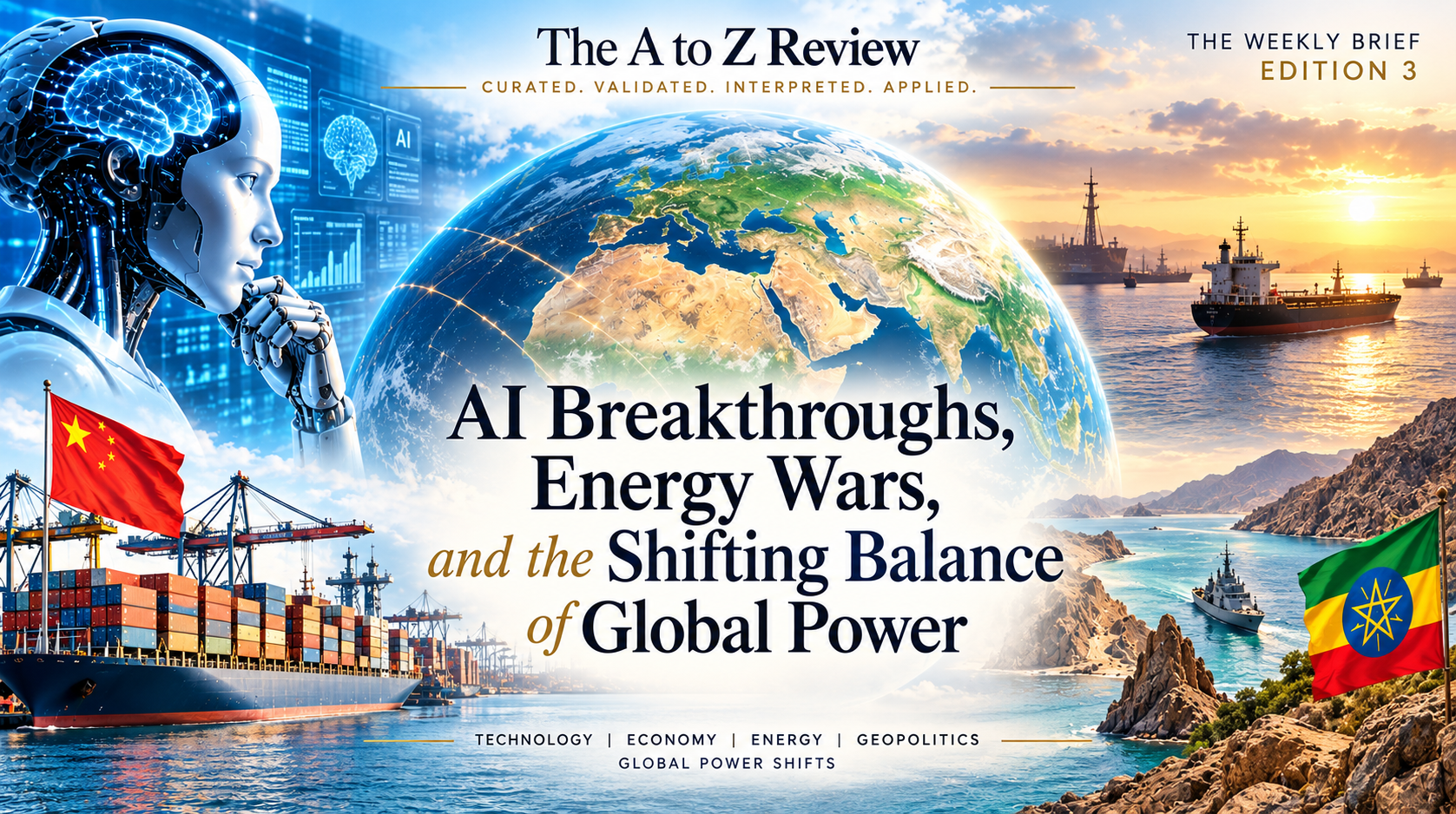
05 Oct AI Breakthroughs, Energy Wars, and the Shifting Balance of Global Power
From renewed inflation and AI-assisted scientific discovery to Ethiopia’s political transition, shifting sanctions policy toward Russia, and growing questions about the financing of technological expansion.
 The A to Z Review
The Weekly News Brief
Curated. Validated. Interpreted. Applied.
Edition 3 (Oct 12 – 18, 2026)
I. This Week in Perspective
The global balance of power is shifting, and this week’s developments reveal how countries, corporations, and institutions are competing to protect their interests, strengthen their influence, and adapt to emerging realities. Economic competitiveness, technological capabilities, energy resources, and political leverage are increasingly shaping who determines the direction of global change.
In the United States, inflation accelerated as rising energy prices pressured households, businesses, and policymakers ahead of consequential midterm elections. Technology stocks suffered sharp losses as investors questioned the enormous financial commitments behind artificial intelligence. Yet AI also demonstrated its transformative potential, with OpenAI publishing mathematical research generated by an advanced model and joining a major initiative supporting mathematicians. The developments raise two different questions: whether the AI investment boom is financially sustainable and how advanced technologies may redefine human expertise.
Beyond the economy and technology, several geopolitical developments illustrate the changing distribution of influence:
- China’s expanding industrial and technological capabilities are challenging established competitors, while Beijing’s proposed technology export restrictions add another dimension to its rivalry with Washington and other economic powers.
- Washington’s decision to waive major Russia sanctions highlights how energy prices and domestic political pressures are shaping foreign policy, while raising questions about the limits of secondary sanctions against countries pursuing their own economic interests.
- Iran’s renewed proposal to reopen the Strait of Hormuz shows how energy disruptions can become negotiating leverage, especially when an opponent faces mounting economic and electoral pressure.
- Ethiopia’s new caretaker administration in Tigray faces the challenge of converting military and administrative control into public trust, political stability, and regional security.
- Growing dissatisfaction with the IMF–World Bank development model reflects the Global South’s continuing struggle for greater representation, economic independence, and influence over international financial institutions.
Three broader questions emerge from these developments:
1. Who is gaining economic and geopolitical leverage? As countries compete over energy, trade, technology, and financial systems, established powers can no longer assume their influence will remain unchallenged.
2. Who will benefit from the next wave of technological and economic transformation? Advances in AI and manufacturing could create extraordinary opportunities, but those benefits may concentrate among those who control capital, infrastructure, and access.
3. Can emerging influence translate into lasting progress? Whether in scientific discovery, economic development, or political transitions, possessing power is different from using it to build sustainable institutions and improve people’s lives.
These questions reach far beyond the governments and corporations dominating the headlines. They affect professionals navigating changing workplaces, entrepreneurs competing in evolving markets, investors assessing new risks, and developing economies seeking a stronger voice in shaping their futures.
This week’s central story is not simply growing uncertainty. It is a shifting balance of influence, and a struggle over who will shape the next chapter of global development.
II. The Weekly 10
1. U.S. Inflation Accelerates as Energy Costs Push Prices Higher
U.S. consumer prices rose 0.6% in September and 3.7% over twelve months, with gasoline prices jumping 9.1% during the month. Core inflation reached 2.6% annually. The figures put renewed pressure on consumers, businesses, and the Federal Reserve as higher energy costs threaten to spread into transportation, food, and services. With the November midterm elections approaching, the economic consequences also have political implications. Americans may debate the causes of inflation, but they experience its consequences every time they fill their tanks or pay their bills. The question now is whether Washington can deliver meaningful relief before rising prices further weaken household finances and business confidence.
2. AI-Generated Mathematics Challenges Traditional Expertise
OpenAI published mathematical results generated by an advanced AI model and announced a $5 million contribution to a Simons Foundation initiative supporting mathematicians. The broader initiative brings together $15 million in funding and resources from the foundation, OpenAI, and Anthropic. The development has stirred debate within a profession that has long regarded advanced mathematical reasoning and discovery as distinctive expressions of human intellectual creativity. Vocal mathematicians have criticized OpenAI and pressured it over concerns about AI’s implications for their profession. Some insiders may also interpret the funding gesture as an effort to ease those tensions and build goodwill. Beyond the debate over professional pride, the larger question is whether AI will diminish human expertise or help mathematicians reach discoveries that were previously beyond their capabilities.
3. Ethiopia Declares Victory as U.S. Diplomacy Raises Questions About Its Red Sea Ambitions
Ethiopia declared victory following its military advances in Tigray and the TPLF’s withdrawal from Mekelle, establishing a six-month caretaker administration to consolidate control and restore governance. But the more consequential developments may be unfolding behind the scenes. Israeli Prime Minister Benjamin Netanyahu spoke with Prime Minister Abiy Ahmed amid growing strategic interest in the Red Sea. Subsequently, U.S. Secretary of State Marco Rubio called Abiy, with Washington emphasizing restraint and respect for territorial integrity while Addis Ababa highlighted their longstanding partnership. Did U.S. diplomatic pressure influence Ethiopia’s decision to halt its military advances, and did it offer any assurances in return? With Ethiopia’s ambitions for access to the port of Assab unresolved and tensions with Eritrea continuing, the declaration of victory raises a larger question: Has a wider Red Sea confrontation been prevented, or merely postponed?
4. Technology Stocks Retreat as Investors Question the AI Boom
The Nasdaq Composite fell approximately 4.5% during the week, compared with a 1.9% decline in the S&P 500 and a 0.7% gain in the Dow. Technology and AI-related companies faced selling pressure as investors questioned valuations, financing costs, and the enormous investments required for computing infrastructure. The retreat raises a question reminiscent of the dot-com era: Are investors financing a technological revolution or another speculative bubble? The answer may be both. The internet transformed the global economy even as many companies that financed its early expansion collapsed. AI could deliver extraordinary productivity gains while leaving investors exposed to overvalued companies and unsustainable business models. The challenge is distinguishing the technology’s long-term potential from the financial expectations surrounding it.
5. China’s Export Surge Tests the Future of Globalization
China’s exports surged 36.3% in September from a year earlier, widening its monthly trade surplus to approximately $133.5 billion. The expansion demonstrates the country’s growing manufacturing competitiveness but has intensified concerns among European and Asian competitors. Critics point to subsidies, industrial overcapacity, and uneven market access. Yet another perspective deserves consideration: should a country that has invested heavily in industrial capacity and technological advancement be expected to slow down so competitors can catch up? Protectionist measures may preserve some domestic industries, but they can also raise consumer prices, reduce competition, and undermine the gains made through globalization and the World Trade Organization. The emerging contest is not simply about China’s exports. It concerns whether global trade will continue rewarding productivity and innovation or increasingly protect established economic interests.
6. Washington Waives Russia Sanctions as Energy Pressures Shape Foreign Policy
President Trump issued an October 16 executive order waiving major provisions of new Russia sanctions legislation, citing U.S. national interests. The decision followed arrangements involving Russian diesel supplies as Washington sought relief from rising energy costs. It also exposes the limits of secondary sanctions meant to pressure countries such as China, India, and Turkey to reduce purchases of Russian energy. These countries have their own economic and strategic interests and cannot be assumed to subordinate them to Washington’s priorities. The decision also comes ahead of consequential U.S. midterm elections, when fuel affordability could influence voter sentiment. The broader Russia–Ukraine conflict has roots extending well before the 2022 invasion, including longstanding disputes over European security and NATO expansion. The sanctions waiver raises a larger question: how sustainable is a foreign policy instrument when enforcing it threatens domestic economic and political interests?
7. China Proposes Technology Export Controls Amid Intensifying Rivalry
8. Iran’s Hormuz Proposal Exposes the Politics of War and Elections
Iran has repackaged an earlier understanding with Washington into a proposal to reopen the Strait of Hormuz within about a week, provided the United States accepts conditions on sanctions, maritime restrictions, and regional hostilities. The accelerated timetable does not necessarily resolve the disagreements that stalled implementation. With U.S. midterm elections approaching, both governments have political incentives beyond the negotiating table. Trump needs lower gasoline and diesel prices but risks appearing weak if he accepts terms portrayed as concessions. Tehran, meanwhile, may use prolonged economic pressure as leverage to influence the elections and discourage future American administrations from pursuing similar military action. Whether a settlement emerges before November may therefore depend as much on political calculations as on the agreement’s substance. The familiar American electoral principle remains relevant: It’s the economy, stupid.
9. Developing Countries Challenge the IMF–World Bank Development Model
The IMF–World Bank annual meetings concluded amid rising debt burdens, inflation, and widening technological inequalities across developing economies. Debt payments now consume about 14% of government revenue in poorer countries, limiting investment in education, healthcare, infrastructure, and economic development. Yet the deeper issue is not simply whether developing countries are managing their finances effectively. The deeper issue is whether the international financial architecture established after World War II continues to favor the interests and influence of its original Western powers. Critics across the Global South question lending conditions, austerity prescriptions, unequal representation, and development models that can perpetuate dependence. The central question is whether these institutions can undergo meaningful reform or whether developing economies will increasingly seek alternatives that provide greater policy independence and financial sovereignty.
10. Corporate Earnings Reveal Uneven Conditions for Businesses and Workers
Early corporate earnings revealed contrasting conditions across banking, technology, energy, and consumer-facing industries. Some large companies remain profitable, while others face pressure from borrowing costs, uncertain demand, and costly technology investments. But corporate profitability does not necessarily translate into greater job security or improved living standards. Employers may respond to financial pressure by slowing recruitment, restructuring operations, limiting compensation growth, or accelerating automation. For professionals, economic uncertainty and AI-driven workplace transformation raise important questions about which capabilities will remain valuable and which occupations face disruption. For investors and business leaders, the challenge is distinguishing sustainable growth from short-term profitability driven by cost reductions that may weaken long-term organizational capacity.
III. The Top 3 | Deep Analysis
Go beyond the headlines. Understand the forces behind them and what they could mean next.
Each week, The A to Z Review selects three consequential developments for deeper analysis. We examine:
- What happened,
- What is driving it,
- How it connects to developments elsewhere, and
- What professionals, leaders, entrepreneurs, and investors should watch next.
During our introductory period, we are making the complete Deep Analysis available to all readers. In the future, this expanded weekly analysis will become an exclusive benefit of paid membership.
This week, we go deeper into three developments that reveal how economic pressures, technological breakthroughs, and geopolitical ambitions are reshaping the global balance of power:
- Inflation Is Back. Can Consumers, Businesses, and Investors Absorb Another Shock?
- When AI Solves the Unsolvable, What Happens to Human Expertise?
- Ethiopia’s Red Sea Ambitions: Did Washington Stop a Wider War or Merely Postpone It?
To read the deep analysis of these three top themes, click here… After reading the analysis, you may sign up for The A to Z Review Substack site in order not to miss future editions…